AI Panic and the Long History of Bad Predictions
Don't be afraid of AI but don't fall in love with it, either.
A bearded man with a thick accent sits in a podcast studio. An earnest, British interviewer sits across from him. He asks a simple question: what will happen to AI in 2027?
The expert’s response? Based on “prediction markets” and comments by “tops of labs,” artificial general intelligence and robotics will combine to create 99% unemployment. Humans will be rendered useless and robots will take over our menial tasks like raking leaves, brain surgery, and childcare. The result? To quote the great Dr. Peter Venkman, “Human sacrifice, dogs and cats living together... mass hysteria!”
What do we do to survive the coming AIpocalypse? Should we shut everything down? Install OpenClaw? Ask AI how to save ourselves? Fortunately, all of that won’t be necessary. Doomers have landed on every intellectual shore since the invention of the written word and this situation is no different. Let’s explore why the End is Not Near.
Idle Hands
The Jura Mountains are harsh in the winter months. Snow settles over the glades and pastures where, all summer, farmers fatten cattle and sheep and prepare cheeses for sale in town. For generations, these mountains moved between two states, open and green under the sun, then sealed in ice as winter took hold.
Families crowded into small houses, often sharing beds for warmth, and worked through the dark months to keep the hearth alive. Travel was hard. Roads disappeared under snow, and the valleys turned inward. Life in these hollows was cold and uncertain, shaped by isolation and the slow passing of days.
For much of that time, survival was the only goal. Families conserved what they had, stretched food as far as it would go, and waited for the thaw. The summer paid for the winter, and little more.
Then, in the 1700s, something changed.
Watchmaking grew into a major trade across Switzerland, France, and parts of Germany, with thousands of pocket watches produced each year. Swiss makers in particular built a reputation for precision and careful work. In Geneva, shaped by Calvinism, cultural norms favored restraint in dress and limited displays of wealth. Craftsmen who once worked in jewelry moved toward watchmaking, which could be framed as useful rather than decorative. Over time, watches still carried status, often richly finished, especially for buyers beyond these stricter communities.
To meet rising demand, watchmakers developed a system known as établissage. Organizers based in towns like La Chaux-de-Fonds and Le Locle spread work across the mountains. They supplied parts, tools, and instructions to farming families. In return, those families produced components through the winter. Wheels were cut and polished. Cases were shaped. Springs were finished by hand at small benches set near windows for light.
It was not a factory system in the modern sense. It was a network. Each household handled a narrow task. The finished pieces moved back down the valleys, where they were assembled into complete watches and sent out into the wider market.
The geography made this possible. The Jura valleys were remote, yet still tied to trade routes. Winters were long, and time indoors could be turned into labor. Protestant refugees, including Huguenot watchmakers, carried technical knowledge into the region. That knowledge did not stay in the towns. It spread, slowly, into the farms.
By the 18th century, the region had become a watchmaking belt without the appearance of one. There were no large industrial buildings, no central floor of machines. There were houses, small rooms, and steady hands, each part of a system that reached far beyond the mountains. Many of these établissage towns became hubs for watchmaking and remain so today. Then something else changed.
Trenton Makes, the World Takes
In the 19th century, this system began to weaken. In about 1760, England began mass-producing textiles with machines, bringing the advent of the Industrial Revolution. The primary job for humans moved from an agrarian society to an industrial one, and nearly everything changed.
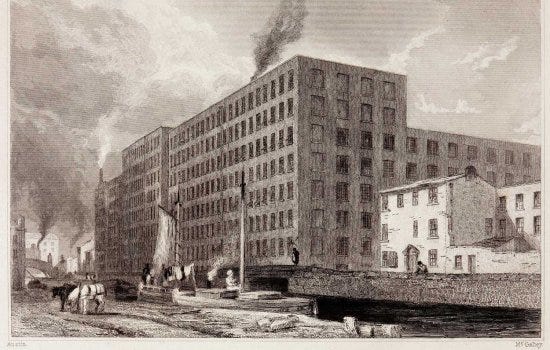
The Industrial Revolution did not eliminate handwork, but it reduced its central role in production and placed it alongside methods that were faster, more consistent, and easier to scale. Nearly everything, from dishes to cigars to pocket watches, became cheaper and more widely available, and that shift rested on a new kind of labor system that concentrated workers in factories where time, motion, and output were closely managed.
The great hubs of manufacturing, Murano for glass, Lyon for silk, and the expanding factory towns in Britain and the United States, showed how production could be organized differently. Work moved into larger, centralized spaces where tasks were divided into repeatable steps, tools and machines ensured uniformity, and output could be increased without relying on the pace of individual craftsmen working at home.
The Industrial Revolution did not eliminate handwork, but it reduced its central role in production and placed it alongside methods that were faster, more consistent, and easier to scale. Nearly everything, from dishes to cigars to pocket watches, became cheaper and more widely available, but the system that produced them depended on dense industrial labor, where, as Engels wrote, “the filth and tottering ruin surpass all description.”
At the same moment, defenders of the factory system pointed to its output and its order. As Adam Smith wrote in The Wealth of Nations, dividing production into small, repeatable tasks could multiply output many times over. In his example of a pin workshop, a group of workers, each performing a single step, could produce thousands of pins per day, far more than any one craftsman working alone.
I have seen a small manufactory of this kind, where ten men only were employed, and where some of them consequently performed two or three distinct operations. But though they were very poor, and therefore but indifferently accommodated with the necessary machinery, they could, when they exerted themselves, make among them about twelve pounds of pins in a day. There are in a pound upwards of four thousand pins of a middling size. Those ten persons, therefore, could make among them upwards of forty-eight thousand pins in a day.
But if they had all wrought separately and independently, and without any of them having been educated to this peculiar business, they certainly could not each of them have made twenty, perhaps not one pin in a day.
The result of this societal explosion was never fully resolved. Goods that had once been rare became common. A pocket watch, once a sign of wealth, moved into the reach of a broader public. At the same time, the conditions under which many of those goods were made drew sustained criticism. Charles Dickens captured the atmosphere in fiction, describing industrial towns as places of “ red brick, or of brick that would have been red if the smoke and ashes had allowed it,” an image that reflects how pervasive and inescapable factory life could feel.
For regions like the Jura, this shift changed the entire economy. The home workshop, tied to the rhythm of the seasons, could not match the steady output of centralized production. As factories expanded elsewhere, they set expectations for price and volume that the older system struggled to meet. Handwork did not vanish, but it moved into a narrower role, often reserved for finishing, adjustment, or higher-end production where precision and reputation still carried weight. The true experts in the Jura could eke out a living making watches by hand, a desirable product for dandies who valued authenticity over mass production. But most people were fine with a watch pressed out of tin that eventually only managed to be right twice a day.
All of this is to say that upheavals have hit humankind in waves, each one reshaping how people live, work, and understand the world around them. The Industrial Revolution did not just alter production; it reordered society and set the stage for what became the Victorian period in the United Kingdom and beyond, a time marked by expansion, classification, and a growing belief that the world could be measured, cataloged, and controlled.
During this period, knowledge itself began to function like an organized field of work. The deciphering of Egyptian hieroglyphs by Jean-François Champollion in 1822 turned ancient Egypt from a field of speculation into something that could be read, studied, and placed within a broader account of human history. Museums filled with objects brought back from expeditions, and scholars set about classifying languages, plants, and human societies into ordered systems that reflected both curiosity and a drive to impose structure.
At the same time, cities drew in those with aptitude and gave them space to develop skills that did not depend on physical labor alone. Children who might otherwise have remained tied to agricultural work were, in some cases, pulled into schools, workshops, and offices where literacy, calculation, and analysis mattered more than strength or endurance. This did not replace manual labor, which remained widespread and necessary, but it did create room for new kinds of work centered on planning, interpretation, and administration, work that depended more on the mind than on the hand.
Education expanded in a more formal way. Systems of public instruction grew across Europe, shaped by earlier models in Prussia that emphasized discipline, literacy, and standardized curricula. These systems produced clerks, engineers, administrators, and officers who could operate within large institutions, whether those institutions were factories, governments, or imperial bureaucracies. Learning was no longer limited to a narrow elite, and it began to serve the needs of a society that required coordination at scale. It was now possible to send an educated young man anywhere in the world — to India, say — and he could, through the benefit of rote memorization and codified rules, mimetically copy an entire culture.
This expansion of knowledge and education ran alongside the outward movement of European powers. Industrial capacity supported longer voyages, larger armies, and more complex supply chains, which in turn enabled the extension of control over distant territories. For example, Nicolas Appert, a French candy maker, heard Napoleon’s call for a method of food conservation that would allow the General to march harder and longer. Appert, understanding the value of bottling wine and milk, began to bottle entire meals, from soups to eggs to whole chickens. Unaware of bacteria, he simply stuffed the bottles with food, corked them, and heated them for an arbitrary length of time, which we now recognize as an early form of pasteurization. An army that marched on its stomach could now march much further, leading to Napoleon’s downfall as he marched to distant Moscow.
Education, mass production, and administration became tools of expansion, providing the structure needed to govern far from home. The same systems that organized factories and cities were applied, often unevenly and with lasting consequences, to the management of colonies.
The pattern is unmissable: a technological shift increases capacity. That capacity produces more goods, more information, and more movement. Institutions rise to manage the flow. People adapt, sometimes slowly, sometimes under pressure, and the shape of daily life changes in ways that are difficult to reverse. And so we come back to our cranky scientist and his erstwhile interlocutor.
The End Is Not Near
I have always loved the work of James Burke and his Connections series. Found in magazines and on television, Burke walked through history like a drunk, stumbling eventually into the bright lights of our modern age. From the compass to the nuclear bomb, from a stirrup to the Internet, Burke saw the thread that connected each innovation to the next, inexorably.
I’ll try to do the same here. The aforementioned dark oracle, Dr. Roman Yampolskiy, is right to raise an alarm about AGI. He is talking about a system that, once it crosses a certain line, will no longer behave in ways we can predict or correct. This fear, according to many experts, is unwarranted and will never happen under the banner of generative AI, aka anything that burbles out of ChatGPT. Instead, we have to look at the long thread of history.
Ed Zitron writes about a bit of Kevin Roose AI doomslop that posits that AGI is only years away. He notes:
Roose’s AGI piece is somehow worse. Roose spends thousands of words creating flimsy intellectual rationalizations, writing that “the people closest to the technology — the employees and executives of the leading A.I. labs — tend to be the most worried about how fast it’s improving,” and that “the people with the best information about A.I. progress — the people building powerful A.I., who have access to more advanced systems than the general public sees — are telling us that big change is near.”
In other words, the people most likely to benefit from the idea (and not necessarily the reality) that AI is continually improving and becoming more powerful are those who insist that AGI — an AI that surpasses human ability and can tackle pretty much any task presented to it — is looming on the horizon.
Zitron hits the nail on the head: the plant manager of the pin factory is telling everyone they will need 1,000 pins in their homes in the next few years.
What the AI doomers are right about is that the world is changing drastically, especially in the realm of menial work primarily associated with parcel delivery and manufacturing. Robots will definitely take away trucking jobs and warehouse work. AI will make middle management roles redundant, forcing folks with “email jobs” to rethink their positions. Short-sighted bosses will set up OpenClaw and think they’ve replaced their accountant, logistics team, and Human Resources crew. They will very quickly find out they are wrong.
Because, as we’ve learned, every groundbreaking technology is absorbed into humanity like a paramecium gobbling up a passing cell, drawn in, broken down, and folded into the body until it is no longer foreign but part of the organism itself, changing its shape, its habits, and its reach, without ever replacing the thing it set out to consume.
AI is supercharging our intellects. Decisions that once took hours now take seconds. Judgments that once required experience are being handed to systems trained on vast, uneven datasets. That’s true.
Robotics are going to replace truck drivers very shortly. This displaces a massive number of human drivers who will have to figure something else out.
AI has already become a cognitive crutch, not unlike the calculator or the smartphone, but more invasive. A calculator replaces arithmetic. A phone replaces memory. AI begins to replace judgment, voice, even the act of thinking through a problem. People are not just using it to check answers. They are using it to form the answers in the first place. That changes the relationship between the user and the tool. It also changes the user.
There is also a psychological layer that is harder to measure. AI psychosis is no longer a fringe concern. Users begin to treat outputs as insight rather than synthesis. They assign intent where there is none. They build a sense of dialogue with a system that has no awareness. The danger comes from the form. These systems speak in complete sentences. They mirror tone and they simulate caring all in an effort to keep you paying $20 a month for a Claude subscription. The human brain responds to that pattern as if there is a mind on the other side and when the computers get fast enough it will seem like that mind is truly thinking.
But all of that is a symptom of a body sick due to a new invader. And thus far, that body has fought off those invaders with ease and the organism that blew out of that sickness is almost always (eventually) fitter, happier, and more productive.
Yampolskiy’s warning is valid. There is a very real chance that if AGI arrives in the form he describes, 99% of us could be displaced, not gradually, but all at once, and on a scale that would wipe out all commerce and growth. In that framing, ninety-nine percent is less a statistic and more of a flashing red sign that says “Ice on Road” in July: it’s helpful, but not right now. His warning is worth taking seriously. Dismissing him outright would be a mistake.
But the chances of that outcome unfolding in any clean, total way remain slim. History does not move in straight lines, and it rarely delivers the full weight of a prediction all at once. Systems resist change, even when change is inevitable. People find uses for tools that their creators did not intend, and they hold on to roles long after those roles seem obsolete on paper.
We have heard versions of this warning before. Thomas Malthus believed population growth would outstrip food supply and push humanity into scarcity and collapse. The Industrial Revolution canceled his prediction. But in his time, he was observing real pressures and projecting them forward. What he missed was the capacity of systems to change under stress. Agriculture did not stand still. Technology did not stand still. Human behavior did not stand still. The pressure did not disappear, but it shifted.
David Ricardo warned that mechanization would drive workers into permanent unemployment as capital replaced labor. He saw the machine as a force that would strip away livelihoods faster than society could adjust. What he did not account for was the way new industries would absorb labor, often in forms that looked nothing like the work that came before.
John Maynard Keynes wrote about “technological unemployment,” the idea that machines would outpace our ability to create new jobs. He expected a future where people would struggle to find purpose in a world with too little work. Instead, work persisted, though it changed shape, and in many cases expanded into domains that had not existed in his time.
The same pattern appears again and again. Each wave of automation raises the same question: what happens when machines take over the work? The answer? Some work disappears. Some work changes. Some work emerges in places that were not visible before. The transition can be painful, even destabilizing, but it is rarely total.
That does not mean Yampolskiy is wrong. It means his warning sits at the edge of possibility rather than at its center. AGI, if it comes, will not land on a blank slate. It will land in a world full of regulation, inertia, politics, fear, and habit. It will be shaped by those forces, slowed by them, redirected by them. The outcome will not be a single moment where everything ends. It will be a series of adjustments, some sharp, some slow, all uneven.
In short, AGI will be born into a world with two terrible foes: human brilliance and human incompetence. We’re already seeing one of those personified by the modern rise of populist governments. We’re just waiting on the brilliance.
Sheep herders in the Jura Mountains turned into watchmakers, who, in turn, turned into bureaucrats. A lacemaker began running a loom, and that lacemaker’s children went on to spread industry globally and build trade routes and technologies that brought distant lands close to home. At the risk of sounding like Buck Rogers, I’ll spare you my expectations of what will happen to the countless people made redundant by AI and robotics (Hint: we’ll need people in space), but in the end, we’ll still need people. We often forget that humans, when faced with cold winters, will always strive to create their own invincible summers.


